

Understanding Champagne Grand Cru Designations
Updated
On this page
- What defines the Champagne region's wine-producing districts?
- How do Champagne producers categorize themselves?
- What are the primary grape varieties used in Champagne?
- What is a Champagne "Prestige Cuvée"?
- How is Champagne sweetness determined and classified?
- What are the best practices for storing and serving Champagne?
When you consider a Champagne Grand Cru bottling, you are looking at a wine from a specific, high-regarded area within the Champagne region. The term "Grand Cru" appears in Champagne, for example in a "Grand Cru blanc de blancs Champagne" or a "Grande Cuvée Grand Cru Blanc de Blancs" from Robert Moncuit. The region divides into wine-producing districts like Montagne de Reims, Vallée de la Marne, and Côte des Blancs. Each is known for specific grape varieties. For instance, Chardonnay is predominantly grown in the Côte des Blancs. That district includes villages such as Avize, Oger, and Le Mesnil-sur-Oger.
What defines the Champagne region's wine-producing districts?
The Champagne region is a single appellation d'origine contrôlée. It divides into distinct wine-producing districts, each with unique characteristics. The main districts include Reims, Marne Valley, Côte des Blancs, Côtes des Bar, and Côtes de Sezzane. These geographical areas are crucial. They shape the diverse styles of Champagne.
The primary grape varieties used in Champagne are Pinot noir, Pinot meunier, and Chardonnay. They grow predominantly in specific districts. Pinot noir and Pinot meunier are dark-skinned grapes that provide length and backbone to the wine. They grow mainly in the Montagne de Reims and the Vallée de la Marne. The Montagne de Reims features north-facing chalky slopes that benefit from warm winds. The Vallée de la Marne contains south-facing chalky slopes. Chardonnay, known for its acidity and biscuit flavor, thrives in the Côte des Blancs, a north-south running strip south of Épernay. This area includes notable villages such as Avize, Oger, and Le Mesnil-sur-Oger. They have east-facing vineyards and a terroir similar to the Côte de Beaune. The varied terroirs contribute to different grape characteristics. That explains why blending juice from various grape varieties and geographical areas within Champagne is common. Each Champagne house blends to achieve a desired style. You can explore these regions and their producers further on our Champagne region map.
How do Champagne producers categorize themselves?
Specific abbreviations on the bottle identify Champagne producers and indicate their role in the winemaking process. Understanding these categories can provide insight into a Champagne's origin and production philosophy.
| Abbreviation | Type of Producer | Description |
|---|---|---|
| NM | Négociant manipulant | These companies, including the majority of larger brands, buy grapes and make the wine. |
| CM | Coopérative de manipulation | Cooperatives that make wines from their member growers, with all grapes pooled together. |
| RM | Récoltant manipulant | A grower that also makes wine from its own grapes; a maximum of 5% of purchased grapes is permitted. |
| SR | Société de récoltants | An association of growers making a shared champagne but who are not a cooperative. |
| RC | Récoltant coopérateur | A cooperative member selling champagne produced by the cooperative under its own name and label. |
| MA | Marque auxiliaire or Marque d'acheteur | A brand name unrelated to the producer or grower. Someone else owns the name, for example a supermarket. |
| ND | Négociant distributeur | A wine merchant selling under his own name. |
What are the primary grape varieties used in Champagne?
Almost all Champagne comes from Pinot noir, Pinot meunier, and Chardonnay grapes. These three are the most common. The 2010 appellation regulations also permit small amounts of Arbane, Petit Meslier, Pinot blanc, and Pinot gris (called Fromenteau in Champagne). Gamay vines, once present in the region, were scheduled to be uprooted by 1942. World War II postponed that process until 1962. Champagne no longer allows the variety.
The designation "Blanc de Blancs" indicates a Champagne made exclusively from white grape varieties, mainly Chardonnay, as noted by Comité Champagne. In rare instances, it may come from Pinot blanc, such as La Bolorée from Cedric Bouchard. Conversely, "Blanc de Noirs" signifies a Champagne made solely from red grape varieties, specifically Pinot Noir and/or Meunier, as explained by Comité Champagne. The flesh of these "black" or "red" grapes is white. The juice, obtained with minimal skin contact during gentle pressing, yields an essentially white wine. Its hue is slightly yellower than wines from white grapes.
What is a Champagne "Prestige Cuvée"?
A prestige cuvée is a proprietary blended wine, typically a Champagne, that a producer considers the pinnacle of their range. The producer crafts these to the highest standards and prices them accordingly, representing the signature style and quality of the house.
Notable examples of prestige cuvées include Louis Roederer's Cristal, Laurent-Perrier's Grand Siècle, and Moët & Chandon's Dom Pérignon. The list also runs to Duval-Leroy's Cuvée Femme, Armand de Brignac Gold Brut, and Pol Roger's Cuvée Sir Winston Churchill. Moët & Chandon's Dom Pérignon pioneered the concept of a publicly available prestige cuvée, launching in 1936 with the 1921 vintage. Prior to this, Louis Roederer had produced Cristal since 1876. That wine served exclusively for the private consumption of the Russian tsar, and it became publicly available with the 1945 vintage. Other houses followed suit in the latter half of the 20th century. They often named their prestige cuvées after significant figures linked to the producer, and presented them in distinctive bottle shapes. These high-end Champagnes are frequently considered for fine wine investment.
How is Champagne sweetness determined and classified?
The sweetness of Champagne is adjusted just after disgorgement by adding a "liqueur de dosage" or "liqueur d'expédition," which is typically a blend of sugar and wine. This dosage fine-tunes the perception of acidity. It also contributes to the wine's aging potential, according to Benoît Gouez, cellar master of Moët & Chandon, cited. Caroline Latrive, cellar master of Ayala, emphasizes that dosage should be subtle to achieve the right balance.
Champagne wines fall into classes based on their sugar levels. The most common style today is Brut.
| Sweetness Classification | Sugar Level (grams per litre) |
|---|---|
| Extra Brut | between 0 and 6 |
| Brut | less than 12 |
| Extra Dry | between 12 and 17 |
| Sec | between 17 and 32 |
| Demi-sec | between 32 and 50 |
| Doux | more than 50 |
| Doux | 50 |
Historically, Champagne was considerably sweeter than it is today. Throughout the 19th and early 20th centuries, it frequently appeared as a dessert wine after meals, rather than with them. Sweetness levels were sometimes referred to by destination country. Examples include "Goût anglais" (between 22 and 66 grams), "Goût américain" (between 110 and 165 grams), "Goût français" (between 165 and 200 grams), and "Goût russe" (between 200 and 300 grams). Only the driest of these, "Goût anglais," is close to contemporary tastes.
What are the best practices for storing and serving Champagne?
Proper storage and serving are crucial for fully appreciating the finesse and aromas of Champagne, according to Comité Champagne. For collectors, these practices help preserve the wine's quality over time.
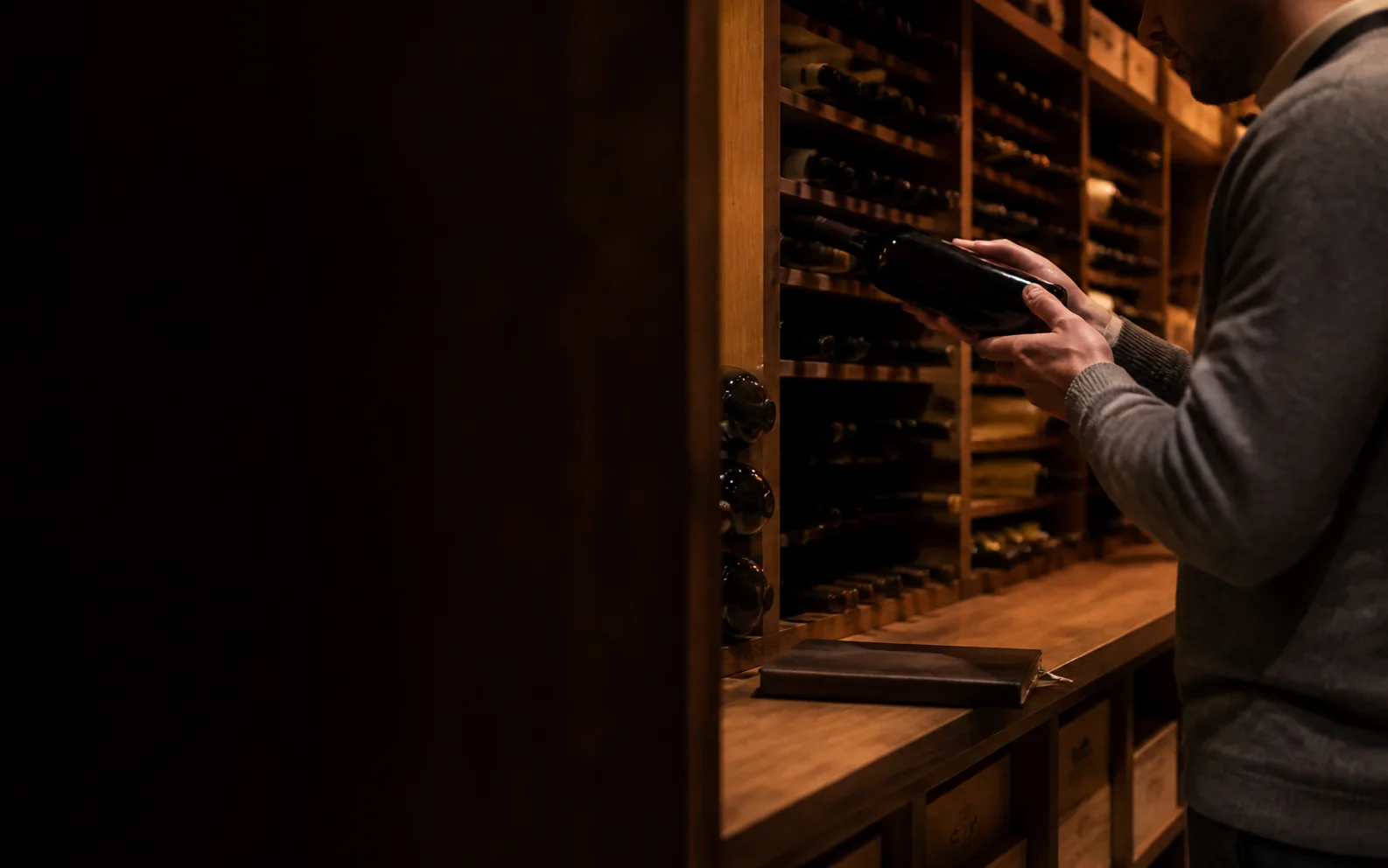
For storage, you can keep bottles upright or on their sides in a cool place. Aim for a constant temperature between 10 and 15°C, Comité Champagne advises. High and constant humidity, between 60% and 80%, is also important. Protect bottles from light, vibrations, and odors, and keep the storage area well-ventilated, Comité Champagne states. Champagne corks are typically agglomerated corks made from three sections, and they change shape over time. Their compressed form becomes more permanent the longer they remain in the bottle. This change can offer clues about the Champagne's post-disgorgement aging. Learn more about how fill levels and condition can affect your bottles in our guide to wine ullage levels.
Serve Champagne chilled, but not ice-cold. The ideal drinking temperature is between 8-10°C, according to Comité Champagne, or 7-9°C. To achieve this, place the bottle in an ice bucket half-filled with water and ice for 20 to 30 minutes before serving. You can also use the bottom of the fridge for a few hours, Comité Champagne suggests.
Regarding glassware, Comité Champagne recommends a tall, bulbous glass with a narrow top, shaped like a tulip. That shape expresses Champagne's full character, aromas, and fine bubbles. Flutes and coupes are frequently used, but they are not considered ideal for this purpose. Flutes aim to reduce surface area, preserving carbonation and maximizing nucleation. The coupe glass, for instance, was designed in England in 1663.
When opening a bottle, hold the cork firmly and rotate the bottle at an angle to ease out the stopper. This method helps prevent the cork from flying out at speed and minimizes spillage, Comité Champagne advise. Sabrage, using a sabre to open the bottle, is a ceremonial technique. For pouring, scientists from the University of Reims, cited, recommend tilting the glass and gently sliding the liquid along the side. That preserves the most bubbles, rather than pouring directly down. Colder bottle temperatures also result in reduced gas loss, according to the same scientists. If you have an unfinished bottle, seal it with a stopper cap designed for sparkling wines. Then place it in a cool spot, upright or on its side, Comité Champagne recommends. The notion that a spoon in the neck preserves bubbles is not true, Comité Champagne clarifies. For more on preserving your collection, consult our guide on how to store wine.
Understanding these nuances of Champagne, from its regional characteristics to optimal storage, empowers you to make informed decisions for your cellar. To compare different Champagnes you own or are considering, use our side-by-side wine comparison feature.