

Professional Wine Storage Cost: What You Need to Know
Updated
On this page
- What are the ideal temperature and humidity for wine storage?
- How does light exposure affect bottled wine?
- What is the best bottle orientation for long-term storage?
- How do closures and the glass-cork interface impact wine aging?
- What are the risks of vibration during storage?
- How is heat damage identified in wine?
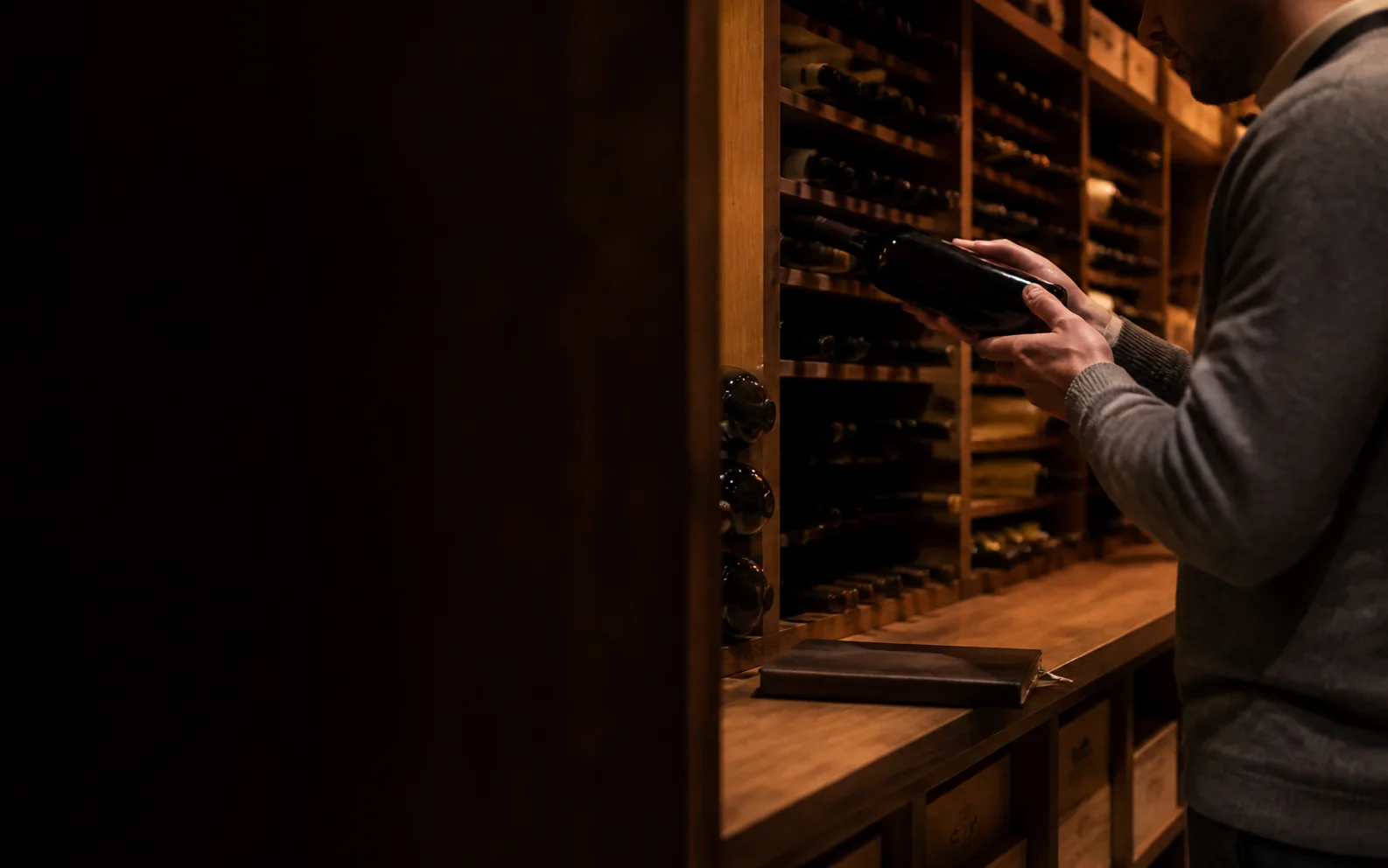
Professional wine storage cost buys one thing above all: optimal environmental conditions. Professional storage protects your valuable collection against temperature extremes, humidity fluctuations, and light exposure. Its value lies in preserving your wine's sensory properties and marketability. Inadequate conditions can significantly impact both. For instance, storing wine at 30°C for 12 months can lead to faulty flavors and decreasing overall quality, as observed by Marais (1986). Temperatures exceeding 40°C can induce visual and sensory changes to a wine in only a matter of days, according to Ough (1986). Amon and Simpson (1986) recommend a cool (15-20°C), dry location, with the cork in contact with the wine. Such controlled environments mitigate risks like cork drying out from low humidity, or lightstruck flavor from light exposure. Your wine then ages as intended.
What are the ideal temperature and humidity for wine storage?
Maintaining a consistent, cool temperature and appropriate humidity is crucial for preserving wine quality. Most experts, such as Jancis Robinson, recommend constant temperatures between 10 and 15°C. Tom Stevenson speculates that 11°C may be the most ideal temperature for storage and aging. Karen MacNeil recommends keeping wine intended for aging in a cool area with a constant temperature around 13°C. We cite both. Amon and Simpson (1986) recommend a cool (15-20°C), dry location. The Comité Champagne recommends a constant temperature of between 10 and 15°C for storing Champagne bottles.
Excessive storage temperatures have a marked effect on the shelf life of bottled wine. Marais (1986) stored wine at 30°C for 12 months. The result was the development of faulty flavors and decreasing overall quality. Temperatures in excess of 40°C will induce visual and sensory changes to a wine, according to Ough (1986). It takes only a matter of days. Ough (1992) states a general rule. Any storage place where the temperature exceeds 25°C for long periods and 40°C for short periods can affect wine quality. Hirlam (2019a,b) advises against thermal cycling, where the temperature varies significantly. Temperatures significantly greater than ambient can cause leakage of wine or movement of cork stoppers, through thermal expansion of the wine. That affects appearance and marketability, even if quality is not necessarily affected, as stated by the Australian Wine Research Institute (AWRI). Cold carries its own risk. Wine held at temperatures that are too cold can freeze and expand. That can push out the cork or crack the bottle, which allows more oxygen exposure.
Humidity is also important, particularly for wines under natural closures. If the air is too dry, corks can dry out. That leads to leakage and lets oxygen enter the bottle, which can cause the wine to spoil or oxidize. Jancis Robinson notes that 75% humidity is often cited as ideal. There is little significant research to definitively establish an optimal range. The Comité Champagne recommends high and constant humidity, between 60% and 80%, for storing Champagne bottles. If conditions are too moist, mould and contamination may occur.
This table summarizes key temperature recommendations and their effects:
| Temperature Range | Effect on Wine Quality |
|---|---|
| 10-15°C | Recommended for constant temperature storage |
| 11°C | Speculated ideal temperature |
| 13°C | Recommended for aging |
| 15-20°C (cool) | Recommended for storage |
| >25°C for long periods | Can affect wine quality |
| 30°C for 12 months | Development of faulty flavors, decreasing overall quality |
| >40°C for short periods | Can affect wine quality |
| >40°C for days | Induces visual and sensory changes |
How does light exposure affect bottled wine?
Light exposure can significantly impact wine quality. It causes undesirable changes to flavor and aroma. Direct sunlight or incandescent light can adversely react with phenolic compounds in wine, creating "wine faults,". This light exposure can lead to the production of volatile sulfur compounds, known as "lightstruck" flavor. That flavor affects the taste of a wine, according to the AWRI. Maujean and Seguin (1983) demonstrated that lightstruck flavor is due to the formation of these sulfur compounds.
The color of the bottle provides varying levels of protection. Light-bodied white wines run the greatest risk from light exposure. They often come in tinted wine bottles that offer some protection. Wines in clear, light green, and blue colored bottles are the most vulnerable. They may need extra precautions for storage. Rankine (1989), cited in AWRI TN09, points to amber glass. It is most effective in excluding wavelengths below about 450 nm. The AWRI has investigated cases of copper instability leading to haze in white wines. A disproportionately high number of them involved wines in clear glass bottles, as stated in AWRI TN09.
Studies highlight the difference in impact between artificial and natural light. Dozon and Noble (1989) exposed still white wines in green glass to fluorescent lamps. They found a statistically significant lightstruck flavor after 31.1 hours. The same wines stored in clear glass developed a statistically significant level of the off-flavor after only 3.3 hours, as cited in AWRI TN09. Direct sunlight, however, provides 4286 times the amount of UV-A radiation as a 36 W fluorescent lamp, according to Gordon Watson, cited in AWRI TN09. Sunlight is therefore likely to be more deleterious to bottled wine quality than electric lighting systems, as stated in AWRI TN09.
| Bottle Type / Light Source | Effect on Wine Quality |
|---|---|
| Light-bodied white wines | Greatest risk from light exposure |
| Tinted wine bottles | Offer some protection from light |
| Clear, light green, blue bottles | Most vulnerable to light, may need extra precautions |
| Green glass, fluorescent light (still white wine) | Statistically significant lightstruck flavor after 31.1 hours |
| Clear glass, fluorescent light (still white wine) | Statistically significant lightstruck flavor after 3.3 hours |
| Amber glass | Most effective in excluding wavelengths below 450 nm |
| Direct sunlight | Provides 4286 times more UV-A radiation than 36W fluorescent lamp |
What is the best bottle orientation for long-term storage?
For most wines with cork enclosures, the general recommendation is to store bottles horizontally or at a slight angle. That keeps the cork moist. Champagne and other sparkling wines may benefit from upright storage instead. Most wine racks hold wine on its side. The idea is that the cork stays moist when it keeps constant contact with the wine. Research in the late 1990s suggested that a slight angle is ideal. The angle keeps the cork damp and holds the ullage air bubble at the top. The argument that this allows a slower, more gradual oxidation and maturation process. You can learn more about wine ullage levels and their impact on condition.
Studies on bottle orientation have yielded varied results. Mas et al. (2002) investigated the impacts of different alignments. They used bottles sealed with six different closures, for a white and red wine. As a general rule, after 24 months, wines stored upright had higher yellow/brown color than those stored horizontally. The differences were not significant. The study showed that oxidation was higher for upright samples sealed with agglomerated cork stoppers, as cited by the AWRI. White wine samples showed elevated acetaldehyde levels from the 3-month timepoint onwards. In another study, Skouroumounis et al. (2005) investigated the developmental characteristics of a wooded Chardonnay and Riesling wine. That study stored samples under differing orientations. Their testing covered a 60-month period, as cited by the AWRI. Bottle orientation, horizontal or upright, had little effect on the chemical composition and sensory properties of the two wines.
Chanut et al. (2023) studied microagglomerated corks with model wine. They tested two storage positions: vertical, with the stopper in contact with the vapor phase, and horizontal, with the stopper in contact with the liquid phase. Position had no significant influence on oxygen transfer through the cork or at the glass-cork interface over a 24-month aging period at 20°C.
For Champagne and other sparkling wines, the recommendations differ. Champagne is often recommended to be stored upright rather than lying on its side. The internal pressure from the trapped carbonic gas provides enough humidity and protection from oxygen. The Comité Champagne, however, states that Champagne bottles "can be stored upright or on their sides" in a cool place, at a constant temperature of between 10 and 15°C. We also cite Caterer Magazine on a claim about the Comité Interprofessionnel du Vin de Champagne (CIVC). The CIVC found Champagne stored on its side aged more quickly, because oxygen seeped in after corks lost elasticity through contact with the wine.
How do closures and the glass-cork interface impact wine aging?
The type of closure significantly affects how oxygen enters the bottle. For corks, the interface between the cork and the glass bottleneck is a major pathway for oxygen transfer. Wine stoppers protect wine from oxidation, as noted by Chanut et al. (2023). Wine still needs controlled low oxygen intakes to evolve and reach its optimal organoleptic characteristics. Chanut et al. (2023) break oxygen transfer from the outside environment into two paths. The first is transfer through the stopper alone, and the second is transfer at the interface between the cork stopper and the glass bottleneck.
Chanut et al. (2023) also studied microagglomerated cork stoppers. They found that the interface between the cork stopper and the glass bottleneck played a significant role in oxygen transfer. Initially, this transfer at the glass-cork interface accounted for more than 30% of the total oxygen transfer. In the presence of model wine, the total oxygen diffusion coefficient for the bottleneck-stopper system was significantly higher after 3 months of storage at 20°C. At that point the transfer at the glass-cork interface accounted for nearly 70% of the total oxygen transfer. The study highlighted one constant. The oxygen diffusion coefficient of the microagglomerated cork wafer alone was not modified, whatever the storage conditions, even after 24 months of aging.
Temperature, however, had a strong impact on oxygen transfer at the glass-cork interface. At 35°C, a temperature easily reached during bottle shipping, significant transfer started beyond 9 months of storage, according to Chanut et al. (2023). At 50°C, this shift occurred within the first 3 months of storage. It led to a "tremendous oxygen transfer" at the glass-cork interface, which could indicate leakage, as stated by Chanut et al. (2023). Chanut et al. (2023) suggest two explanations. The first is a partial melting of the paraffin and silicone surface treatment agent on the cork. The second is a modification of the mechanical properties of the stopper.
Natural cork stoppers still account for nearly half of the wine closure market. A variety of other stoppers are now available, including cork-based, synthetic, and glass stoppers, as well as screw caps. Each offers different oxygen barrier properties, according to Chanut et al. (2023). For wines bottled with alternative closures, humidity and concerns about oxidation are not as pronounced. These closures have grown popular only relatively recently, and their usage has increased. There have not been many opportunities for research into their long-term storage and aging potential. Understanding these factors is key to fine wine investment.
What are the risks of vibration during storage?
Anecdotal information suggests that vibration contributes to the accelerated aging of wine, with adverse effects. This remains a research area with relatively little data. A study by Chung et al. (2008), showed that vibrations of different frequencies had their own distinct effect on the chemistry of wine. The study concluded that "Vibration could be used to accelerate the ageing of wine, but in most cases, this may lead to negative effects on wine quality. Therefore, to store red wines with limited changes in physicochemical properties, vibrations should be minimized,". This suggests that minimizing vibration is a prudent approach for long-term wine preservation.
How is heat damage identified in wine?
Identifying and demonstrating heat damage in a wine can be difficult, according to the AWRI. That damage follows exposure to temperature extremes during storage or transport. Results depend mostly on the degree of damage and the age of the wine. Robert Parker (2008) makes an estimate in his wine buyers guide, as cited by the AWRI. Somewhere between 10 and 25% of wines sold in the USA have been damaged due to exposure to extreme heat.
The most effective way to assess damage is by comparison, as recommended by the AWRI. Compare the suspected damaged wine to samples of the same wine that have not been exposed to extreme conditions. Those samples can be holdback stock, or stock not exported and held at constant temperature. The AWRI therefore advises exporters to retain holdback samples and store them under known conditions for comparison.
Current methods for assessing whether a wine has experienced heat damage include a combination of chemical, physical, and sensory tests, as detailed by the AWRI:
- Visual assessments: Look for signs of leakage, closure damage, wine travel or seepage on corks, increased ullage, and label damage.
- Chemical analysis for white wines: This includes color development (yellow/brown color measured by OD420) and free and total SO2 levels. SO2 levels are compared to levels at bottling, and losses are compared to closure trial data, which provides an indication of the expected rate of SO2 loss under ideal conditions.
- Chemical analysis for red wines: This includes spectral measurements for color and phenolics, as well as free and total SO2 levels.
- Sensory analysis: Typically, this involves assessment of two dozen of the damaged stock compared to two dozen of the same wine not exposed to the extreme conditions. Wines exposed to extreme temperatures tend to lose their fresh fruity characters and show more developed fruit characters. At extreme levels of temperature exposure, oxidized and cooked characteristics can be observed.
These rigorous assessment methods underscore the importance of proper storage conditions for your collection. You can further explore how to store wine effectively.
When you weigh the value of professional storage, set the potential costs against the protection it offers your collection. We do not provide specific pricing. You can still analyze the factors that influence value through our per-case cost table set beside our market price data. For a broader understanding of market dynamics, explore our fine wine market index. If you are considering acquiring more wine, our guide on how to buy wine at auction offers valuable insights. Our all-in cost calculator can help you estimate total expenses. Should you decide to part with some of your collection, our guide on how to sell fine wine provides essential information.